

The Carney Doctrine
On the small revolution in Canadian Foreign Policy
When Mark Carney was first elected, he came to power partly on the assurance that he would secure a good deal for Canada. It is almost November and with the latest breakdown in trade negotiations, there appears to be no end in sight for American tariffs.
In another age, it is likely that a breakdown in negotiations with the US would have led to an all-hands-on-deck response. Canadian prosperity and security after all, is safeguarded by Uncle Sam.
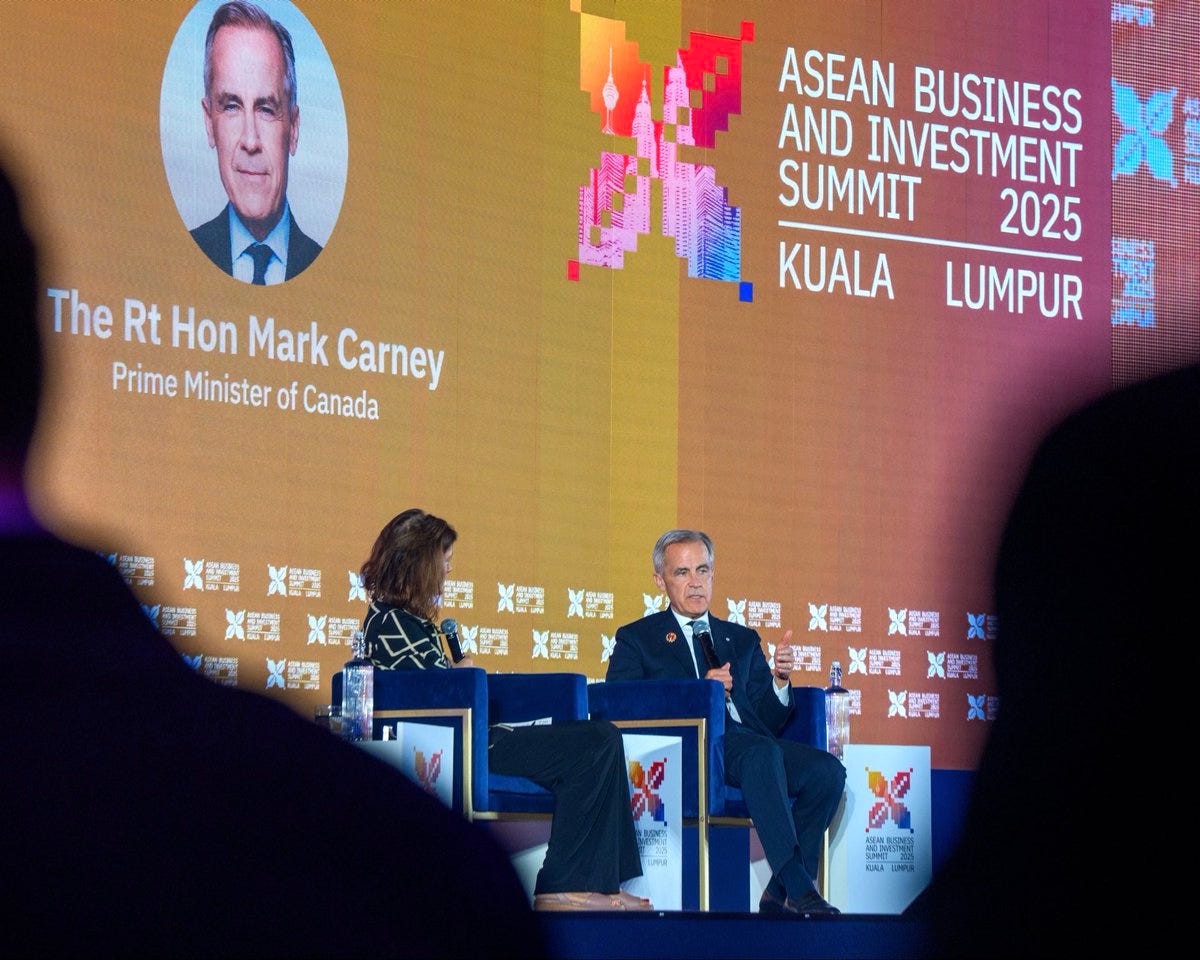
Although managing the relationship remains a critical issue, the PM is on equally important business in Asia. A meeting with Xi Jinping is in the offing as the Canada-China diplomatic reset continues. Beyond this, the PM is expected to attend the ASEAN summit and promote Canada as a strong economic partner to the trade bloc.
It is a reflection of the rapidly shifting weight of foreign policy for a Prime Minister. In the past, foreign policy essentially amounted to keeping the Americans happy and writing diplomatic communiqués with the Europeans. Today, the PM faces no choice but to travel extensively to build economic and security ties with the world.
Thus far, Carney has spent a considerable amount of his time in power on diplomatic business. Many of his cabinet ministers have done the same to push collaboration in a more substantive direction.
Anita Anand, for example, made major trips to India and China earlier this month to meet with her counterparts from both countries. It is no surprise, then, that Carney managed to get 1:1s with both Xi and Modi.
Ministers of Defense and Procurement have travelled to Germany and Korea as they continue to evaluate options for the looming acquisition of submarines. Lastly, Energy Minister TIm Hodgson has been in Europe to trumpet the potential of Canadian LNG exports.
Again, there is no other way around this. It is impossible to build a strong, good-faith relationship with another country solely by relying on the career bureaucrats working at Global Affairs Canada offices in Ottawa. Despite the advances of technology, face-to-face diplomacy remains the single best way to build and sustain ties.
This is a change that will likely survive long past the Carney government. The Canadian and American national interests are no longer in natural alignment, and it is on Ottawa to step up for itself. While cooperation may continue in matters of security and trade, fundamentally Canada needs to secure its economic and security interests.
Foreign policy is no longer a luxury file that can be relied upon to escape domestic political drama. It no longer exists in the margins of government. It is now central to whether Canada thrives or drifts. A country that once coasted on geography and goodwill must now actively compete for markets, alliances, and relevance.
That requires a political class willing to see foreign affairs not as photo ops or symbolic missions, but as nation-building in real time. The same ambition that once drove continental railways and peacekeeping must now animate trade corridors, energy diplomacy, and security policy.
Carney’s critics argue he is stretching Canada too thin—pursuing summits over substance. But the alternative is retreat. Sitting still in a world that is rearranging itself guarantees decline. The uncomfortable truth is that Canada’s traditional model of soft diplomacy, anchored in deference to Washington, has no future in a multipolar system.
Canadian prosperity cannot be maintained by focusing exclusively on the domestic sphere alone. If anything, the domestic arena is now sharply dependent on Canada’s actions abroad.
This new realism is not romantic. It is transactional, restless, and sometimes awkward. But it is also necessary. In Asia, the Middle East, and even Europe, Canada’s leverage depends on its ability to show up, to invest, and to deliver. Partnerships will not form on charm alone - the Trudeau decade showed that.
The test for Carney, and for whoever comes after him, will be whether this diplomatic surge is matched by domestic credibility. Allies and rivals alike measure a country by what it can execute at home: its infrastructure, its energy policy, its fiscal steadiness.
Without that base, even the most active diplomacy becomes theatre. LNG is not exported by a diplomatic treaty, but by thousands of kilometres of pipeline and coastal refineries.
Still, something has shifted. Ottawa has finally accepted that the world owes it nothing. The American umbrella is thinner, the global order is noisier, and middle powers must define themselves through motion, not posture.
That realization may prove to be Carney’s most enduring legacy. He did not invent Canada’s new foreign policy, but he is the first to practice it with conviction — one that recognizes the age of complacency is over, and the age of self-reliance has begun.